Politics




Election to the Sabzevar City Council, Iran;
Local chiefs of the Ashanti in Mampong, Ghana;
Protest about public transport in Spain;
The United Nations General Assembly;
Coronation of King Rama X of Thailand
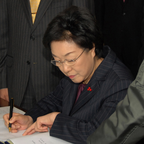
Han Myeong Sook, former Prime Minister of South Korea
It may be used positively in the context of a "political solution" which is compromising and nonviolent, or descriptively as "the art or science of government", but also often carries a negative connotation. The concept has been defined in various ways, and different approaches have fundamentally differing views on whether it should be used extensively or limitedly, empirically or normatively, and on whether conflict or co-operation is more essential to it.
A variety of methods are deployed in politics, which include promoting one's own political views among people, negotiation with other political subjects, making laws, and exercising force, including warfare against adversaries. Politics is exercised on a wide range of social levels, from clans and tribes of traditional societies, through modern local governments, companies and institutions up to sovereign states, to the international level.
In modern nation states, people often form political parties to represent their ideas. Members of a party often agree to take the same position on many issues and agree to support the same changes to law and the same leaders. An election is usually a competition between different parties.
A political system is a framework which defines acceptable political methods within a society. The history of political thought can be traced back to early antiquity, with seminal works such as Plato's Republic and Aristotle's Politics in the West, and Confucius's political manuscripts and Chanakya's Arthashastra in the East.
Contents
Etymology
The English politics has its roots in the name of Aristotle's classic work, Politiká, which introduced the Greek term politiká (Πολιτικά, 'affairs of the cities'). In the mid-15th century, Aristotle's composition would be rendered in Early Modern English as Polettiques [sic], which would become Politics in Modern English.
The singular politic first attested in English in 1430, coming from Middle French politique—itself taking from politicus, a Latinization of the Greek πολιτικός (politikos) from πολίτης (polites, 'citizen') and πόλις (polis, 'city').
Definitions
- Harold Lasswell: "who gets what, when, how"
- David Easton: "the authoritative allocation of values for a society"
- Vladimir Lenin: "the most concentrated expression of economics"
- Bernard Crick: "a distinctive form of rule whereby people act together through institutionalized procedures to resolve differences"
- Adrian Leftwich: "comprises all the activities of co-operation, negotiation and conflict within and between societies"
Approaches
There are several ways in which approaching politics has been conceptualized.
Extensive and limited
Adrian Leftwich has differentiated views of politics based on how extensive or limited their perception of what accounts as 'political' is. The extensive view sees politics as present across the sphere of human social relations, while the limited view restricts it to certain contexts. For example, in a more restrictive way, politics may be viewed as primarily about governance, while a feminist perspective could argue that sites which have been viewed traditionally as non-political, should indeed be viewed as political as well. This latter position is encapsulated in the slogan the personal is political, which disputes the distinction between private and public issues. Instead, politics may be defined by the use of power, as has been argued by Robert A. Dahl.
Moralism and realism
Some perspectives on politics view it empirically as an exercise of power, while others see it as a social function with a normative basis. This distinction has been called the difference between political moralism and political realism. For moralists, politics is closely linked to ethics, and is at its extreme in utopian thinking. For example, according to Hannah Arendt, the view of Aristotle was that "to be political…meant that everything was decided through words and persuasion and not through violence;" while according to Bernard Crick "politics is the way in which free societies are governed. Politics is politics and other forms of rule are something else." In contrast, for realists, represented by those such as Niccolò Machiavelli, Thomas Hobbes, and Harold Lasswell, politics is based on the use of power, irrespective of the ends being pursued.
Conflict and co-operation
Agonism argues that politics essentially comes down to conflict between conflicting interests. Political scientist Elmer Schattschneider argued that "at the root of all politics is the universal language of conflict," while for Carl Schmitt the essence of politics is the distinction of 'friend' from foe'. This is in direct contrast to the more co-operative views of politics by Aristotle and Crick. However, a more mixed view between these extremes is provided by Irish political scientist Michael Laver, who noted that:
Politics is about the characteristic blend of conflict and co-operation that can be found so often in human interactions. Pure conflict is war. Pure co-operation is true love. Politics is a mixture of both.
| This article uses material from the Wikipedia article Metasyntactic variable, which is released under the Creative Commons Attribution-ShareAlike 3.0 Unported License. |